Palate Savvy/Sud de France Instagram Live Broadcast: Gaillac
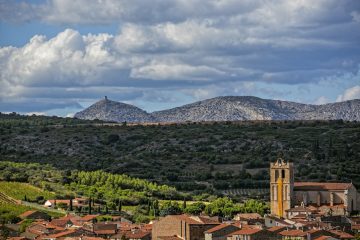
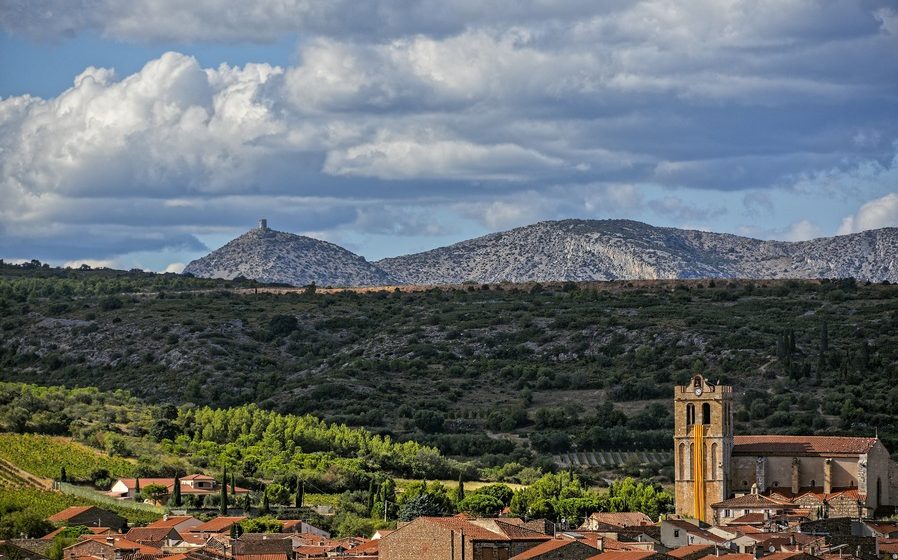
Occitanie, the administrative region in France that covers a good portion of the country’s southwest, from the right bank of the Rhône River to the east, to the eastern edge of Aquitaine to the west, contains several wine-producing zones that remain relatively unknown. It’s hard to put a finger on which part would qualify as the most underappreciated – so many excellent wines come from here, whether or not one takes price into account (alas, a few too many mediocre ones, too, though modest pricing offers some compensation). But, for the missed opportunities for excitement of those who remain unaware, Gaillac certainly belongs near the top of the list.
While identified as a ‘Southwest’ wine region, Gaillac is in fact wedged between the Southwest and the Languedoc, and might almost be understood as belonging to a group of appellations that one might dub “Mediterranean-Atlantic,” including Limoux, Cabardès, and Malpère. I say “almost,” since Gaillac is over an hour drive between the Languedoc portions of this coterie. Still, Gaillac takes on as much of the heat from Mediterranean as the freshness the trio I’ll dub “LCM” enjoys from the Atlantic. That Gaillac has as many, perhaps more, olive trees than can be found in LCM is telling. (NB – This is a purely anecdotal observation. I don’t know how many olive trees there are – but I do know that there are far fewer oliviers here than in other parts of the Languedoc, and at least one farmer in Gaillac just planted a bunch).
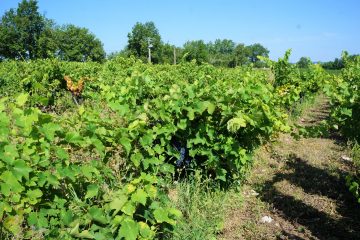
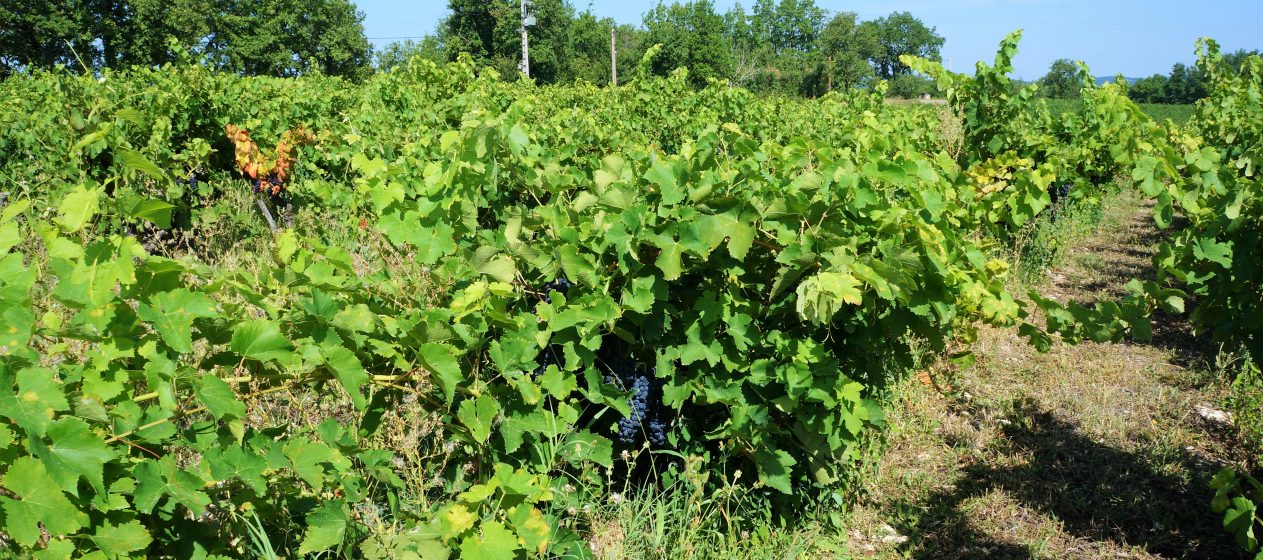
Beyond the confluence of Atlantic and Mediterranean climates (and, according to the metéo – Gaillac is warmer today than the LCMs), Gaillac’s greatest attribute is diversity: diversity in soils, diversity in wine styles, and diversity of grapes
I’ll get to that in a moment, but first a little history lesson (surprise). Gaillac, as many other places in southern France, has the Romans to thank for their wine industry. Records show that vines were planted, and wine was made here for commercial purpose from the first century BCE, though likely the history is a bit older. A part of the Roman province of Narbonnesis that extended from the Rhône Valley to the east to about 50 kilometers west of the present town, Gaillac was recognized as being one of Gaul’s grand crus. As in most of the rest of France, the fall of Rome brought with it the rise of the Church and vines served both heavenly and earthly purposes. Crusades – the Albigensian crusade against the Cathar movement was so named after the Gaillacaise town of Albi that was a center of Cathar activity (a complicated story that will discussed at another time. For now, understand that Cathars were an anti-materialist, dualist movement that eschewed the corruptions of the physical world in favor of a pure reality of the spirit. The worldly Church didn’t take kindly to the implication and declared a crusade against the heretics in 1204 . French king Philippe II, who saw the advantage of taking down the Toulouse-based ruling nobles who supported the Cathars, slowly jumped in – he was otherwise busy battling the English – followed by his son Louis VIII. The Cathars lost, either killed, went underground, or forced into cruel repentance) did Gaillac winemakers no favors (more than a few suffered death and a lot worse). Yet, while traumatized by the experience, Gaillac got by through the fortune of favor its wines enjoyed by the English court – which effectively ruled much of southwest France from the first third of the fourteenth century until the end of the (bit longer than) Hundred Years’ War in the middle of the fifteenth. English taste for Gaillac wine was reestablished at a 50 wine keg bacchanal François I threw for Henry VIII in Calais in 1520, though, of course, historical events closed and reopened the tap several times in subsequent years, decades, centuries.
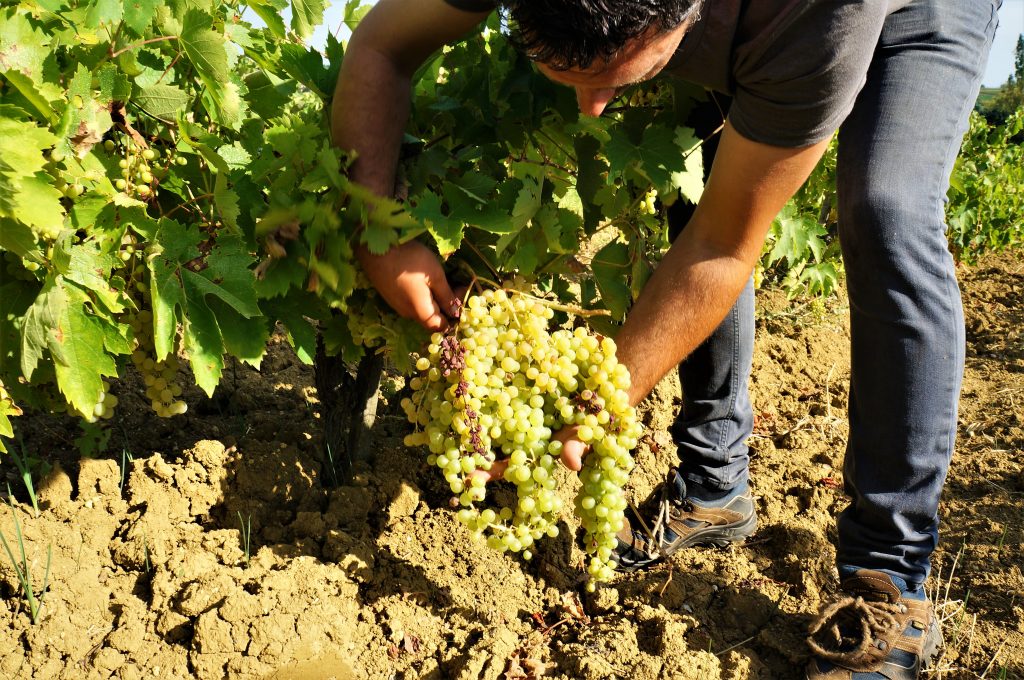
Difficulties in the international market or not, Gaillac’s wines had a reputation that needed protection, particularly against counterfeiters from the outside attempting to pass their mediocre, or adulterated wines off as noble Gaillac. While controls were difficult to enforce, the local wine producers, supported by the local aristocrats that lorded over the territory, established certain quality standards, among which was the interdiction of importing and therefore, blending wines from the outside with those produced within Gaillac’s realm, the exclusive use of pigeon manure to fertilize vineyards, and the obligation to stamp a cockerel logo on every cask of Gaillac wine exported from the territory. That symbol is still in use today.
With 3200 hectares (7900 acres) in production for appellation-certified wines (others including IGP, bring to total planted area to 6800 hectares), makes Gaillac one of the largest appellations d’origine protégées in Occitanie, following Corbières, Minervois, and Côtes du Roussillon in the Languedoc-Roussillon.
Abord the banks of the Tarn River, the appellation has three distinct terroirs: the terraces on the left bank of the river with soils composed of round stones (galets roulés) sand, and graves; the hillsides on the right bank that are largely clay and limestone; and a plateau of limestone above the right bank. Another zone of schist also exists to the east of the town of Albi, in the direction of the Languedoc.
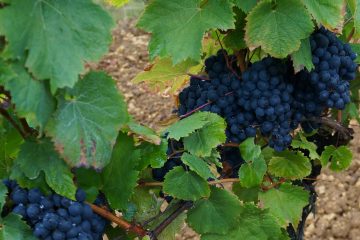
The variety of grapes is astounding, especially given the fact that many of them are not found elsewhere. Among reds is Prunelart, Braucol (synonym of Fer aka Fer Servadou aka Mansois aka Pinenc aka…), Duras, Syrah, Gamay, Merlot, and the Cabernets. Among whites are Ondenc, Loin de l’œil (Len de l’El), Mauzac Blanc, Muscadelle, Sauvignon Blanc, and Sémillon.
Okay, you say that’s a good number, but except for four of the grapes: Prunelart, Duras, Ondenc, and Loin de l’Oeil, the others are found elsewhere. True. But, those are the grapes that were authorized for Gaillac AOP when the rules were made some decades ago, that is, when considerations such as economic viability and scale of production were primary. In fact, there is a whole menagerie of historic, Gaillac-only cultivars that have garnered increased intention in recent years, started largely by the efforts of Robert Plageoles, followed by those of his son Bernard at their eponymous family estate Domaine Plageoles. In the 1970s Robert Plageoles took upon himself to work only with autochthonous grapes, the four mentioned above, plus…(get ready)…Verdanel, seven types of Mauzac (Blanc, Noir, Vert, Gris, Rose, Roux, and one I can’t figure out. On a visit two years ago, Bernard told me about seven, but I clearly didn’t write quickly enough, and his website only shows six), Jurançon Noir, Prunelart Blanc (and I was excited about Prunelart Noir), Piquepoul Gris, Piquepoul Noir (which is a grape permitted in Châteauneuf-du-Pape), Morrastel (which is likely the same as Graciano in Spain), and two I’ve never heard of: Mourtes and Marocain Gris. Finally, there’s one for which I have special affection: Nehelescol, otherwise known as Géant de Palestine, which was identified in the Hebrew Bible as the giant grapes Moses’ spies saw being carried on a litter in the Land of Canaan.
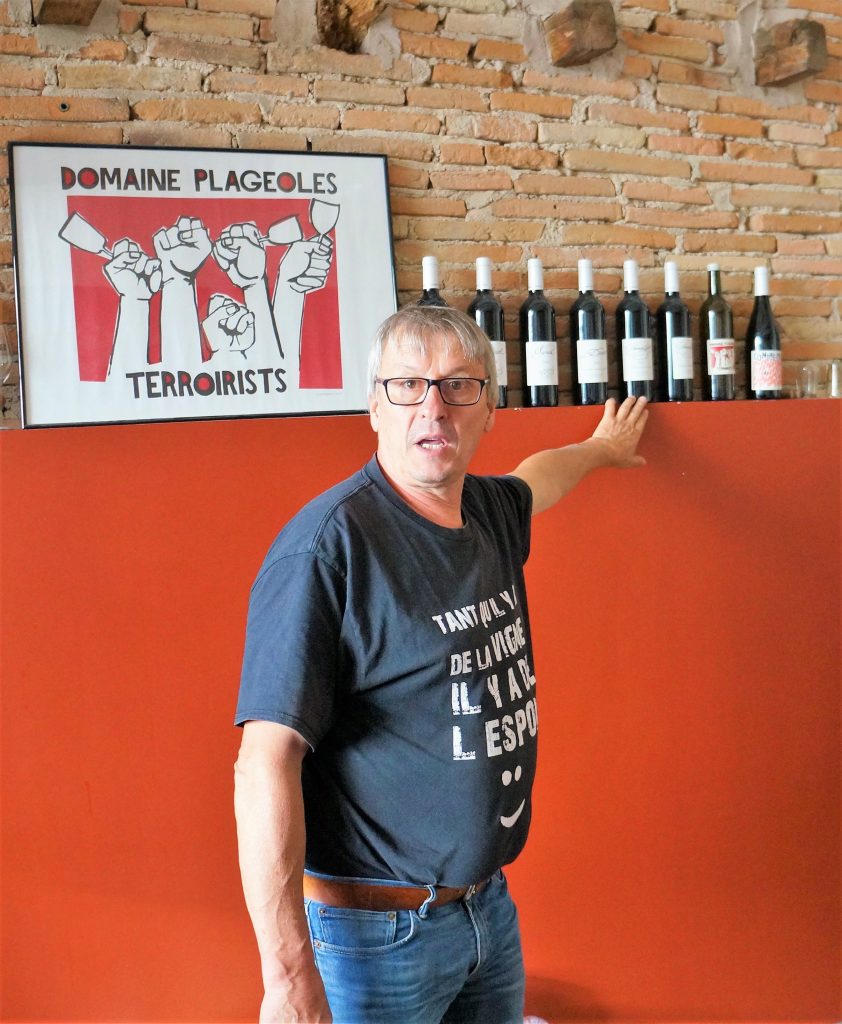
While the Plageoles might have been outliers in the 1970s, they are certainly far from that today. Whereas the trend in the 1970s, 80s, and 90s had distinctly been toward ‘international’ grapes like Sauvignon Blanc, Cabernet France, and Merlot, more attention is distinctly given to the indigenous varieties, especially the Loin de l’Oeil, Ondenc, Braucol, and Duras. The more obscure ones have their partisans, many of them acolytes of the Plageoles. It seems almost unnecessary to say it, but for these producers, vineyard and winemaking practices veer toward the natural side of things, with relatively little intervention on the vines and in the winery. Wines not made with authorized grapes – no matter how ancient their local provenance, are classified as IGP (Vin de Pays) du Tarn, or Vin de France. Of the latter, depending on one’s perspective, one might thrill to, or be repulsed by the potential array of unexpected aromas and flavors, including an occasional hint of volatility. I fall firmly in the thrilled camp – but not always, and I am delighted by the range of producers who work with great attention to clean viticultural practices, who also know how to add some polish, too.
The vastness of possibilities in Gaillac wines extends to wine styles, too, which is possible unparalleled in any appellation of France. Dry reds whites, and rosés are the norm, ‘traditional’ as well as a nouveau style made from Gamay in the style of Beaujolais nouveau. But there are also three styles of sparkling wine: so-called méthode gaillacoise, aka, méthode ancestrale (found in Languedoc’s Limoux, too), méthode traditionnelle (or the classical or ‘Champagne method, méthode champenoise, a term though, not the method, applicable in Europe only to wines made in the Champagne region), and perlé, a fresh, tingly wine with slight effervescence derived traditionally from bottling a dry, light wine just before alcoholic fermentation has ceased, or more usual today among more commercially expedient producers, by dosing a dry white with a touch of CO2 . Then, there is the vin de voile, a dry white aged under a blanket of flor, a yeast stratum that can insulate white wine resting in a not full barrel, much like Spain’s fino sherry or the Jura’s vin jaune, then left to oxidize, and finally, a sweet wines, mostly white, but also red, too. Ah, and there is some superb eau de vie made here, too, including that of Domaine Cazottes, who ranks among the best distillers in France.
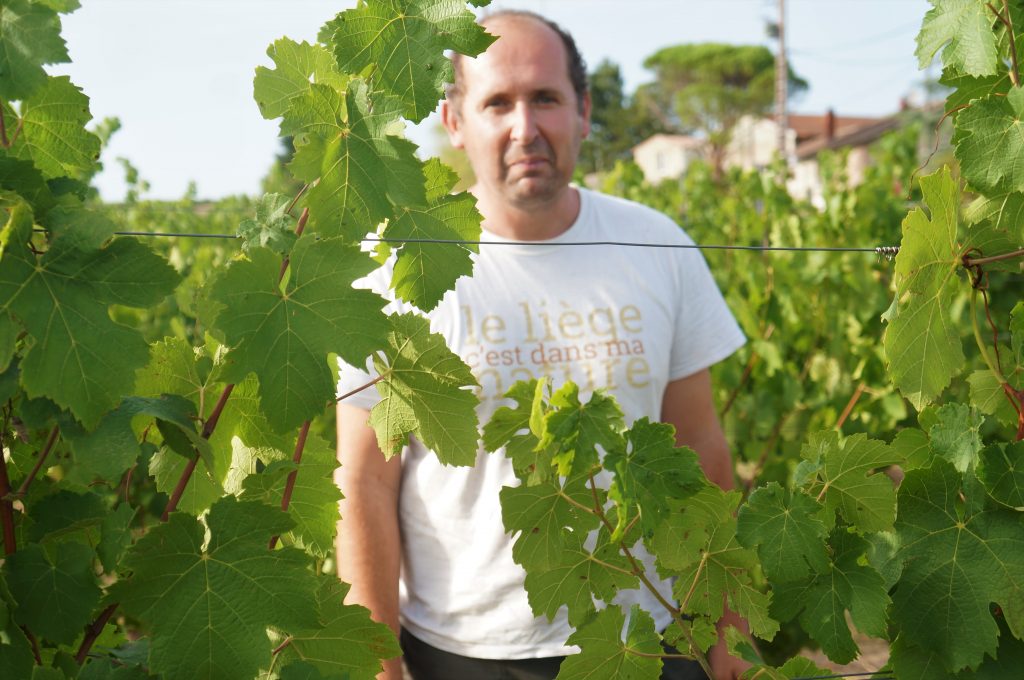
Some Gaillac producers to look for (not at all complete)
“Classicists”: Domaine du Moulin (possibly the most dynamic Gaillac producer on the market today, Nicolas Hirissou is noteworthy for his finally crafted wines, organic viticulture – which has become common in the area, his new olive plantings, and, not the least, his passion for falconry – or in his case, eaglery.), Domaine Rotiers, Domaine d’Escausses, Domaine des Terrisses, Domaine Gayssous, Domaine Sarrabelle, Domaine de Borie-Vieille.
“Natural”/Avant gardistes: Domaine Plageoles, La Ferme du Vert, Domaine de Causse Marine, L’Enclos des Braves, Domaine de la Ramaye, Domaine Cazottes, Domaine Philémon,
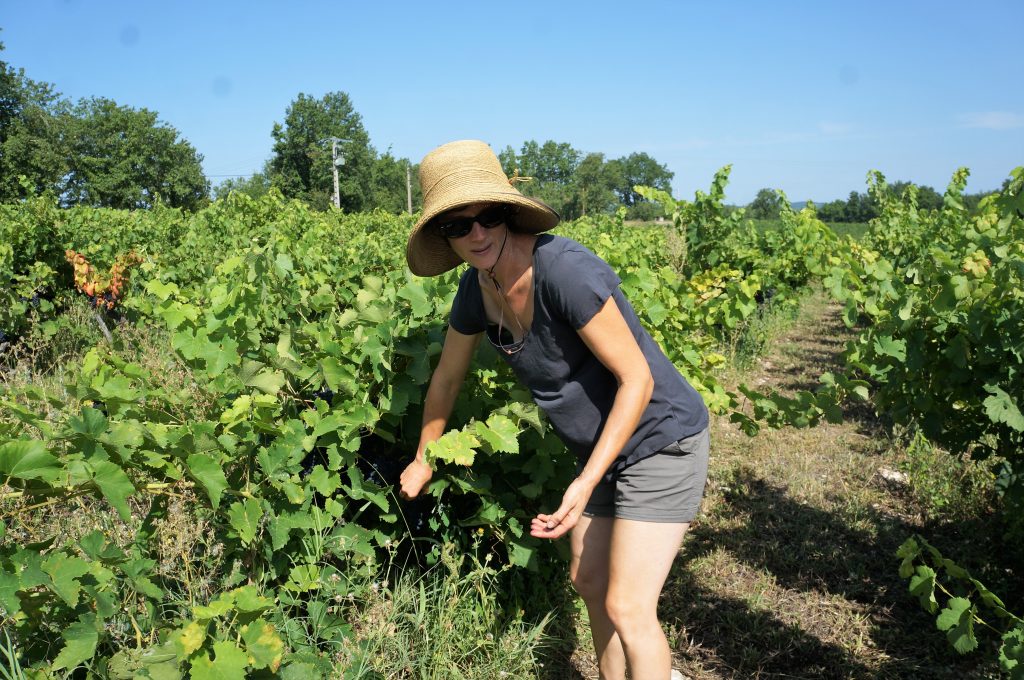
Books should be written about the glories of Gaillac – perhaps a project for the future – but for now, I invite you to enjoy a brief video Instragram Live Broadcast taking place on Friday, April 17, at 1pm (19h France, 10am California) on the Sud de France NY Instagram page: @suddefranceny. The video will be up for 24 hours, then, hopefully, it will be available elsewhere. Maybe here.
Palate Savvy/Sud de France Instagram Live Wine Basic Seminars: Vin Doux Naturel!
Roussillon is one of those places in which one realizes that France is not just France. That is, that France, one of the oldest coherent nation states in Europe – or possibly, in the world, in fact, contains several different cultures within it. Within modern memory, say the past century, France’s connection to Alsace was contested, to speak mildly, by Germany. Today many Corsicans seek to separate their enchanted Ile de Beauté from the cruel, albeit elegant clutches of Paris. And, there is a revival of interest regional languages: Breton, Occitan, Picard, Basque, Alsatian, etc.
But, perhaps no region in the continental territory of France (as opposed to an island like Corsica) is so distinctly non-French as Roussillon – aka the Pays Catalans. Crossing into the Pyrénées-Orientales département from neighboring Aude, one might be struck by the fact that many signs are in two languages – French and Catalans. A similar phenomenon exists in parts of the Languedoc, too, signs giving both French and Occitan names, but that’s more symbolic than practical, since few Languedociennes actually do speak Occitan in any practical way. Not so in the Roussillon, where Catalan is the language of choice in many places. (Though, use of French doesn’t provoke the same issues as using Castellano in some places across the frontier with Spain. I recall a visit with a small number of other American writers – to winemakers in Catalonia of Spain – for the sake of clarity, I’ll use ‘Catalunya’ to refer to the Catalan portions of Spain). The latter addressed us in Catalan, which none of the Americans spoke. Some of us – those who spoke Spanish or French – got the gist of what they were saying, but there were gaps. When I asked a couple of questions in Spanish, I was inevitably answered in Catalan. Bothered by what I saw as a gratuitous assertion of Catalans nationalism, I said in Spanish: I don’t understand why you have us here if you don’t want to communicate with us in the most direct way. Whatever your politics, you all speak Castellano. Some of us do, too. And some of us speak French. All of us speak English. None of us speak Catalan. So, could you please use one of those other languages?” After an embarrassing pause, the speaker changed to Castellano.)
The connection between the Languedoc-Roussillon, Roussillon especially, and the Iberian peninsula, extends over millennia. Clearly, they’re neighbors. The halcyon days of Roman Empire brought the Via Domitia to the region, which, its completion in 118 BCE connected Italy with important Roman colonies in Hispania. Portions of the Via Domitia became an important southern trail for pilgrims traveling to the shrine of St James in Galicia: Santiago de Compostela /St Jacques de Compostelle, and today, it is largely the footprint of France’s A9 highway, aka La Languedocienne in the Languedoc and La Catalane in Roussillon. Way further back in history, Hannibal purportedly left a trail of elephant droppings on the same path as he made his way to Rome in the third century BCE.
At various points in history apart from Rome, portions of the Languedoc-Roussillon and what is today Spain were governed by the same rulers. In the 13th century CE political disruptions brought or withdrew Iberian control from the region. Jaume I (aka James I, aka Jacques I ) was born in Montpellier. After assuming the throne of Aragon (Spain) , he then conquered the Moorish rulers of the Balearic Islands, and put much of today’s Languedoc-Roussillon under the suzerainty of Mallorca, which was eventually governed by his son Jaume II from Perpignan, today Roussillon’s capital and most important city. King Louis IX, in his contestations with various powers in Europe, the Aragonese not the least, exerted tremendous pressure on Jaume I (and, visa versa). Their accord of 1258, known as the Treaty of Corbeil, more or less settled their differences. Louix IX renounced claims in the Iberian peninsula – especially in Catalunya and much of the coastal portions of the Languedoc-Roussillon, and Jaume I did the same for his claims in Gaul (i.e., France), including more inland portions of today’s Languedoc-Roussillon. Enthusiasts of the gerrymandering game might take delight the map of the Languedoc that was drawn, which gave Montepellier and Aumelas to Jaume, and Béziers and Narbonne – which almost touches the Mediterranean between Montepellier and Perpignan – to Louis.
Before his passing in 1276, Jaume passed control of Mallorca (including Montpellier) to his son Jaume II (other sons got other portions of his possessions), which, again, was ruled from Perpignan and included Montpellier. Montpellier was, as it remains today, a leading center for research and knowledge. Among Jaume II’s subject was the physician/scientist/alchemist/astrologer/theologian/diplomat Arnau de Vilanova aka Arnauld de Villeneuve aka, many other versions. As one might assume through his extensive CV, Vilanova was a man of many talents (it’s hard to know if the expression ‘Jack of all trades, Master of none, might apply. We know he certainly never was able to turn lead into gold). Of most importance to the history of wine was his articulation in 1285 of the process he called ‘mutage’ to stabilize and preserve the sweetness of a wine through fortification with alcohol. Known as vin doux naturel these fortified sweet wines centuries later became the basis of the wine economy in the Roussillon, which in the 20th century, recognized five distinct appellations in which these sorts of wines were made: Banyuls, Banyuls Grand Cru, Maury, Muscat de Rivesaltes, and Rivesaltes. I’ll save discussion about these for another time. Jaume II, who was said to have been a great fan of these sorts of wines (which were forerunners of Port and Madeira), awarded Vilanova a patent for the process in 1299. It seems that patent offices worked slowly back then, too.
For the next two and a half centuries, minus a few adjustments (not the least of which was the Jaume III’s sale of Montpellier to the French crown in 1349), the Roussillon remained in Spanish hands until 1659, when the Treaty of the Pyrénées that ended the Thirty Years War between France and Spain, ceded control of the Roussillon to France, as it remains to the present.
Despite being officially French, Catalan identity has remained strong in Roussillon. Something like 35% claim to speak it fluently, and another 25% say they understand it. Indeed, le Pays Catalans arguably shares a great deal more with the Catalans across the border than they do with even their co-regionalists the Languedocians. That Catalan nationalists refer to the Roussillon as ‘Nord Catalunya,’ is as much descriptive as it is aspirational. Interestingly, though, the affection and support French Catalans might feel for their kin next door, has not translated to significant demands for Catalan independence from France, even to join a Catalunya made independent from Spain. Social scientists have undoubtedly examined the reasons why – comparing the grievances the Catalan communities in each country have suffered. Surely, in France, there was no anti-Catalan campaign that compared to that in Spain during the nearly 40-year Franco dictatorship. Moreover, relatively speaking, Catalunya is a prosperous, industrial region compared to the Roussillon, whose economy remains rooted in agriculture and tourism. Whereas people in Barcelona might complain that they send more money to Madrid than they receive in support of services, the same cannot be justifiably said of Perpignan tax-payers and Paris. (Which isn’t to say that people don’t still complain). Folks in the Roussillon potentially have a lot more to lose by leaving France than those in Catalunya have in seceding from Spain.
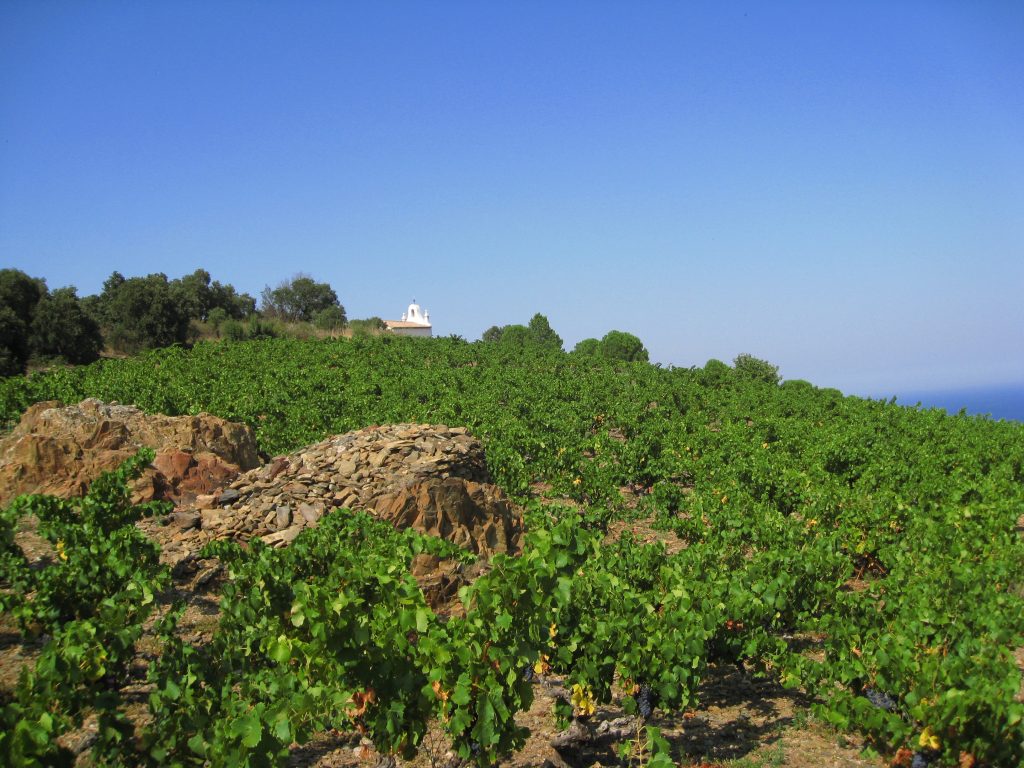
While the Roussillon is connected to the Languedoc by a hyphen (a few other things, too), one might say that there seems something a touch different about its wines. While appellation rules have similar requirements in terms of permitted grape varieties, for reds, the southern French collection that includes Grenache Noir, Carignan, Cinsault, Syrah, and Mourvèdre, many of the wines seem – well, more Catalan than French. It’s hard to quantify why, exactly. They just do, maybe on account of shared local flora, maybe because Grenache spelled with an ‘x’ – Garnatxa – takes a different form, maybe because winemakers on both sides of the border share thoughts in a language that is their own? Anyway, I’m generalizing. There are several expressions of wine in the Roussillon, just as there are in Catalunya.
(I’ll add here that folks in the Fenouilèdes, in the northwest corner of Roussillon, tend to consider themselves French rather that Catalan, though their wines share the same character as others from Roussillon).
There is a great deal to say about this all, but to make things simple from the start, I’ll be doing another Sud de France Instagram Live Wine Basics seminar tomorrow (Wednesday, April 15) at 1pm EST (19h France, 10am California) in which I talk about some the history, the appellations, the grapes, and the wines of Roussillon. Fifteen minutes, give or take, short and sweet.
Please go to @SuddeFranceny on Instagram to join live. The broadcast will be up for 24 hours from them, and hopefully archived on this site afterward.
Palate Savvy/Sud de France Instagram Live Wine Basic Seminars: Cahors!
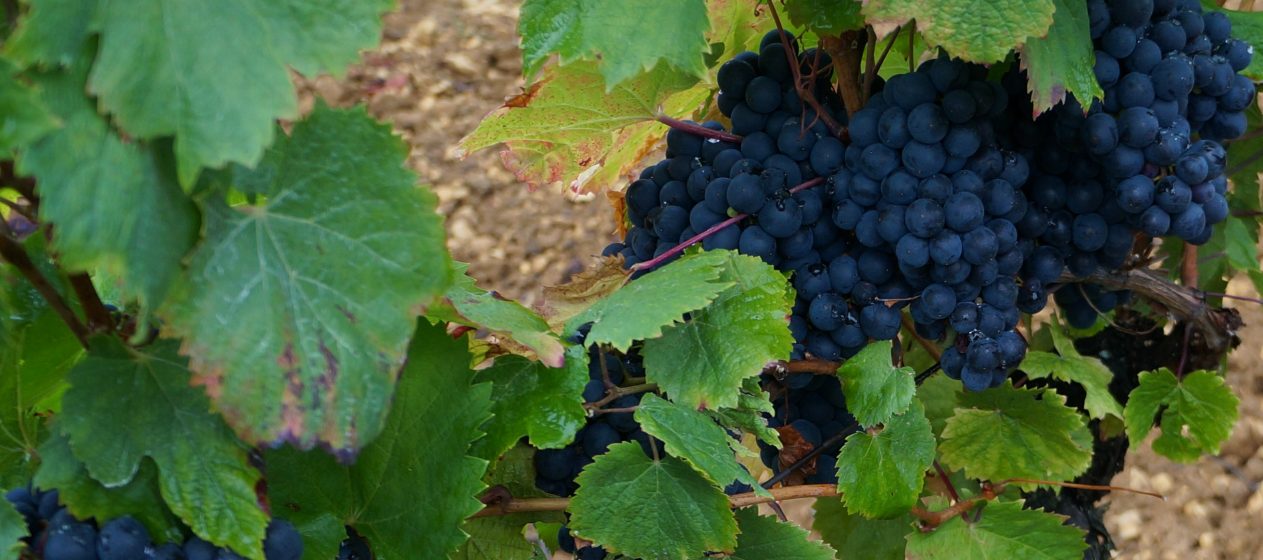
Cahors was one of the first French wine regions – other than Bordeaux, Burgundy, or Champagne – that I came to know by name. If memory serves, my acquaintance came courtesy of Kermit Lynch in the late 1980s. I had heard of Cahors and was fascinated by the moniker some gave it: Black Wine. For a long time, I thought that “black” was a reference to the dark color typical of Malbec-based wines, echoing a certain mysterious power. I later learned that the term’s origins were not doing Cahors a favor, with the so-called black wine referred to grape must that had been boiled down into a sort of sweet sludge, which was then reconstituted in water, alcohol, or maybe especially thin wine. More gentle folks might have simply let the grapes raisinate a bit, perhaps air dried (though the region gets damp not so long after harvest), or baked in ovens. Given the glories of Veneto’s dried grape wine Amarone, that practice might not have been a bad thing at all. Alas, few, if any, Cahors producers are recorded in history to have brought that sort of attention to their black wine. (There is at least one excellent producer doing so today: Jean-Luc Baldès of Clos Triguedina, who makes a wine he dubs “The New Black Wine” by drying grapes in a prune dehydrator. It’s truly delicious). In any case, the wine in question, Clos la Coutale, was distinctly more ruby in color rather than black (current releases still are), and not at all the brooding vintage I had expected. But, it was a terrific bistro wine offered for a very fair price, and, while I eventually experienced other Cahors that grabbed my attention more, Coutale is always among the value wines I’m happy to turn when occasion calls.
Cahors is an unexpectedly pretty place. The town itself, founded by the Romans, is charmingly bourgeois, but not annoyingly so, with several monuments to its heyday during the late medieval, early Renaissance period. Pilgrims traveling from northern France, the Low Countries, or Germany to the shrine of Santiago de Compestela (St Jacques de Compestelle) in Spain, often passed through Cahors, and the town enjoyed a certain prosperity. And, local winemakers, who had a good market for whatever they concocted – black or otherwise) were happy, too. In what is possibly a local legend, one of the more important Avignon Popes, Jean XXII hailed from Cahors and he supposedly demanded that Malbec, called Auxerrois or Cot, be planted near his papal residence so he could easily enjoy the type of wine he preferred.
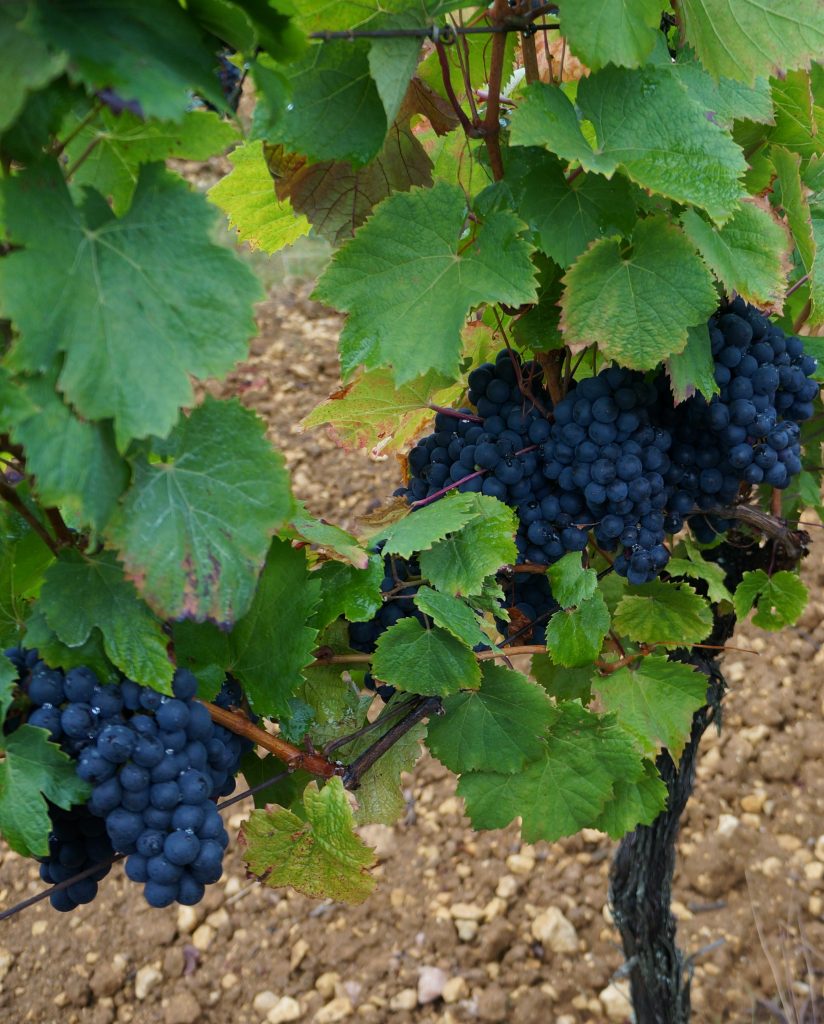
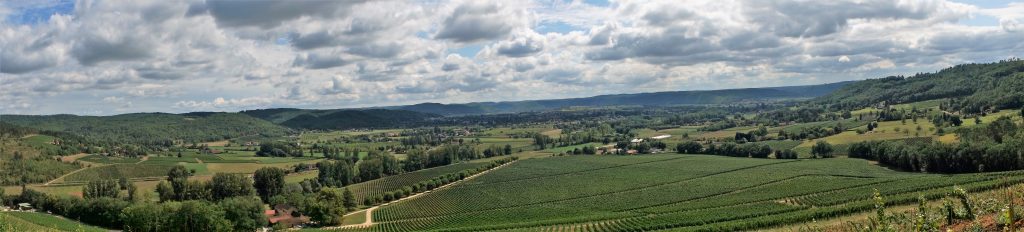
Cahors vineyards, which cover about 4400 hectares (nearly 11,000 acres) are planted largely around the serpentine contours of the Lot River that cut, millions of years ago, through a limestone plateau that was the remains of a receded seabed. Vineyards start from near the river, on mixed alluvial soils that gradually becomes more calcareous as they progress up three naturally formed terraces, eventually leading up steep hillsides – or coteaux – again of diverse soils types, then, finally, the Causse, or plateau. In terms of quality, it isn’t fair to generalize which zone or terrace is the sweet spot, though the richer soils near the river tend to yield grapes with less complexity. Some of my favorite producers occupy the second and third terraces, but again, there are plenty of others higher up that warrant attention.
Tomorrow (Friday, April 10), I’ll be giving a live, brief, Cahors wine basics seminar on Sud de France’s Instagram page. I’ll quickly cover some of its history, it terroirs, its challenges, and where things are going today. There’s a lot to talk about when it comes to Cahors, but I’ll keep this presentation short and sweet. Again, please go to Suddefranceny on Instagram to watch live at 1pm EST, or enjoy the story for 24 hours after that. Please join me.
Palate Savvy/Sud de France Instagram Live Seminars
Hello everyone!
Taking advantage of all the out-of-the-office time we have been given, I am conducting a series of short (15-20 minute) Instagram live broadcasts on Wednesdays and Fridays, at 1pm EST (that’s 19h in France, 10am in California) on the wines of the Occitanie region in the south of France. Occitanie is a political region that encompasses a portion of the southern Rhône Valley, the Languedoc-Roussillon and much of France’s Southwest (SudOuest). These mini-seminars are done courtesy of Sud de France, and the presentations will be simple and to the point, great for people who are curious about learning more about wine, but hopefully, interesting to those who already have some knowledge about it. Those who listen closely and correctly answer a question I present during the broadcast will be entered into a lottery to win wine from the region, and probably more (pending!).
Friday, April 3: Wine Basics
Wednesday, April 8 : Picpoul de Pinet
Friday, April 10 : Cahors
Wednesday, April 15 : Côtes du Roussillon
Friday, April 17 : Gaillac
Wednesday, April 22 : Limoux
Friday, April 24 : Rivesaltes
Please go to @Suddefranceny on Instagram to view, And, make sure to also follow me on @palatesavvy.
Palate Savvy Seminars and Dinners
Wine is a marvelous, bewildering thing. It can be so easy to enjoy, yet also, so intimidating. There is much to know: grape varieties, vintages, regions, white, red, pink and now, orange(!), organic, biodynamic, ‘natural.’ And, God-forbid you choose the wrong wine with dinner! 
Fortunately, a bit of lively information, along with a few sips (or more), can make the whole world of wine both comprehensible and exciting.
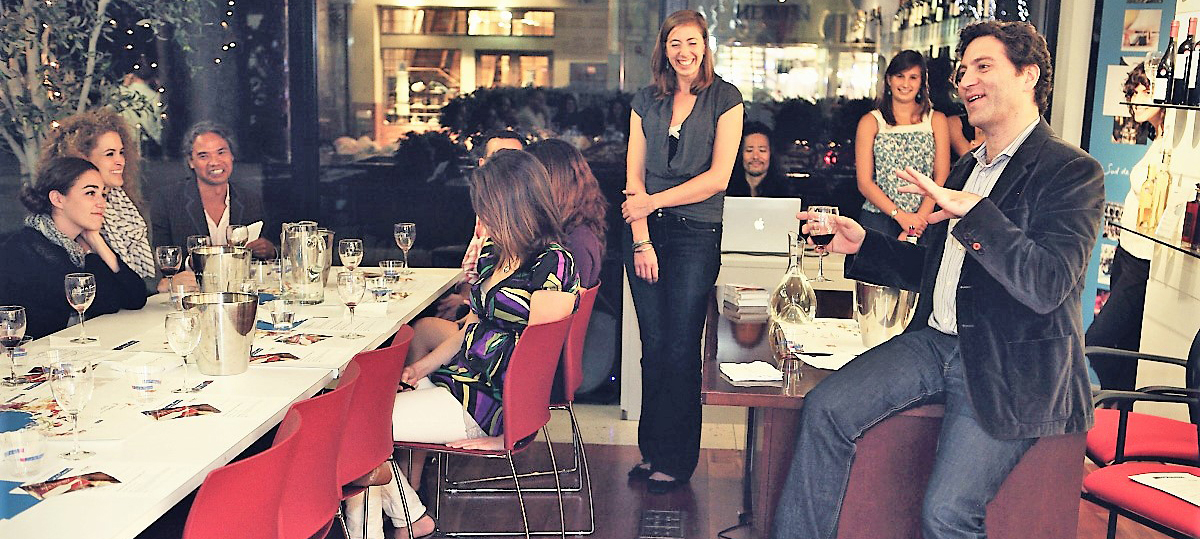
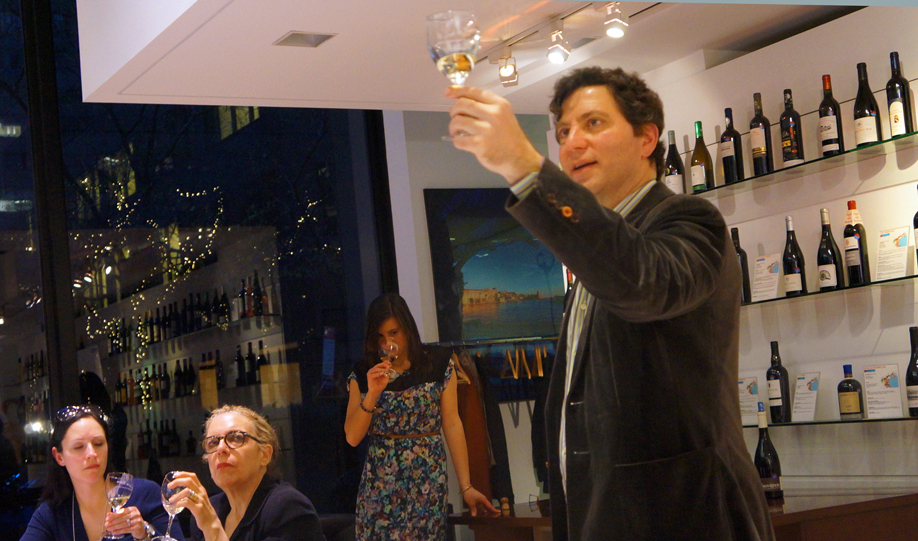
Palate Savvy wine seminars and dinners are fun, engaging ways to increase wine knowledge. Not only will you learn about fundamentals like grape varieties, regions, and wine styles but you’ll also learn some of the histories and cultures that underline them. And you’ll discover strategies for pairing wines with multiple dishes, as well as tips for selecting wines for any occasion, whether in a shop or in a restaurant.
Most seminars feature an interactive talk about wines and their history, plus a tasting of between 5 to 10 different wines that illustrate the focus.
They offer terrific opportunities for, team building, professional development, increasing social currency (who doesn’t want to be the person who can choose a great wine for dinner?), and personal enjoyment.
Events can be tailored to meet client needs, but here are some popular themes:
<b>The Great Challenge</b>: France versus the New World, a comparative tasting of wines from classic French wine regions matched against New World acolytes. For example: Bordeaux versus Napa Cabernet, Red Burgundy versus Oregon Pinot Noir, Sancerre versus New Zealand Sauvignon Blanc, Hermitage versus Australian Shiraz.
<b>Mediterranean Savvy</b>: A tasting of wines made around the Mediterranean, for example: Spain, France, Italy, Greece, Lebanon, North Africa
<b>California Dreaming</b>: A vinous tour through the state’s diverse wines. Not just Cab, Chardonnay, and Zinfandel!
<b>Wines of Summer</b>: Not only white and rosés
<b>Bubble, Bubble</b>: The world of sparkling wine from Champagne to Cava to Prosecco to Sparkling Shiraz(?)!
<b>Region focused</b>: Experiencing the diversity to be found within a single, classic wine region, like Bordeaux, Burgundy, the Rhône Valley, the Loire, Rioja, Tuscany, Piedmont, etc.
<b>Country focused</b>: Highlights that reflect a country’s viticultural heritage. Tour de France, Giro d’Italia, Vuelta a España, etc.
Cost: Pricing is based on a few factors, including the theme selected (wines from some regions simply cost more than others), the number of people in attendance, venue, and selection of glassware, etc. Generally, though, seminars run for between $40-90 per person. Personalized dinners with guests at your home or in a restaurant can also be arranged. Palate Savvy is happy to discuss multiple possibilities to offer an enjoyable, informative event that meets your budget.