South of France Festival – Interview
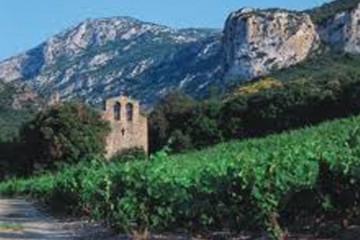
CHIC.TV for a South of France festival celebrating its wine and food on the East River, with Chef Cedric Tovar, Pamela Wittmann, Jamal Rayyis and Marianne Fabre-Lanvin of the Maisons de la Region Languedoc-Roussillon in NYC.
The Judgment of Princeton
Journal of Wine Economics, Volume 7, Number 2, 2012, Pages 143–151
George M. Taber
On May 24, 1976, a wine tasting took place in Paris at the InterContinental Hotel
that wine-and-food critic Anthony Dias Blue has called the most important in the
20th century. Englishman Steven Spurrier, who owned a wine shop and wine school
in Paris called Caves de la Madeleine, staged the event. He was in his 30s and
regularly did things that the French wine establishment never thought of trying. His
wine school, for example, was the first ever in Paris. Once he had a comparative
tasting of the five famous French First Growths, something the masters of French
wines never did.
In the fall of 1975, an American working for Spurrier, Patricia Gallagher,
suggested that he do a tasting of California wines. Visiting Americans, including
the New York Times writer Frank Prial, had been telling them that interesting
but little-known boutique wines being made there. Gallagher explained to Spurrier
that the following year was the bicentennial of the American Declaration of
Independence, and anniversary events were being done all around the world. Why
not a California wine tasting in Paris sometime in 1976? Spurrier quickly accepted
the idea, and the two started their planning.
Over the Christmas holidays of 1975, Gallagher visited northern California
and with the help of Robert Finigan, a leading American wine critic who lived in
San Francisco, visited some leading Napa Valley wineries. She returned to Paris
with a few bottles of the wines, which convinced Spurrier that the California
products were worth showing to the French. He traveled to California in the spring
of 1976 and like any other tourist went around the area buying his favorite wines
to ship back to Paris. He decided to concentrate on Chardonnay and Cabernet
Sauvignon because those were the most prized French varieties and also the best
wines the Californians were making.
After returning to France, Spurrier put together an esteemed panel of nine French
judges. The Englishman was well respected in the French wine community, and his
group included Aubert de Villaine, the co-owner of Burgundy’s Domaine de la
© American Association of Wine Economists, 2013
Block Island, RI. email: george@georgemtaber.com.
Journal of Wine Economics, Volume 7, Number 2, 2012, Pages 143–151
doi:10.1017/jwe.2012.25
Romanée Conti, and Christian Vannequé, the head sommelier of the Tour d’Argent
restaurant. The French wines were Chardonnay and Cabernet Sauvignon, and
the country’s best labels, including Ramonet-Prudhon Bâtard-Montrachet and
Château Haut-Brion.
When the scores were tabulated, the wine world was stunned. The winners:
Chateau Montelena Chardonnay and Stag’s Leap Wine Cellars Cabernet
Sauvignon. The tasting put California wines on the map and encouraged
winemakers in many countries to make wines as good as the French.
While planning the 2012 conference of the American Association of Wine
Economists at Princeton University, Orley Ashenfelter and Karl Storchmann, two
officers of the American Association of Wine Economists, decided to replicate
something like the Paris tasting. But instead of French and California wines, this
time it would be French wines and local New Jersey wines. People have been making
wines there since colonial days, although after American Prohibition most of them
were underwhelming sweet ones made with local blueberries and peaches. A small
cadre of vintners, though, has been striving in recent years to produce better wines
using the world’s leading viniferas.
The idea of the Judgment of Princeton, as the tasting was informally
called, began on Mother’s Day 2011 on a patio outside Amalthea Winery in the
small southern New Jersey town of Atco. Owner Louis Caracciolo had invited
Ashenfelter and Storchmann to a tasting of his wines. Caracciolo, who studied food
engineering at the Pratt Institute in New York City and has a host of patents in that
field, planted his first vineyard in 1976. At first, he drew on his experience helping
his Italian-born grandfather make wine. Unlike most New Jersey winemakers,
Caracciolo wasn’t interested in sweet fruit wines. His goal was to produce ones
made with French grapes and in the French style. His model was Château
Margaux, and he had spent many days with its director Paul Pontallier, when the
American was explaining his new technology for cleaning wine barrels with ozone
water.
Caracciolo’s production was modest, less than 5,000 cases annually, but he
slavishly followed the strictures of winemaking that he learned at Margaux and
other French wineries. In fact, Amathea’s seven Europa wines are styled after great
French wines. Europa I, modeled after Margaux, is a blend of 75% Cabernet
Sauvignon, 20% Merlot, and 5% Cabernet Franc. Europe VII, a tribute to Château
Figeac, is a third each of Cabernet Sauvignon, Cabernet Franc and Merlot.
Europa IV, in the style of Cheval Blanc is 66% Cabernet Franc and 33% Merlot.
New Jersey winemakers watched Caracciolo’s progress with interest and respect,
and some began to follow him. Charlie Tomasello, a New Jersey producer whose
blueberry wine sells well around the world, nicknamed him Louis Lafite.
Caracciolo took the bold step of holding blind tastings that pitted his own wines
against some of the best in the world. His first such tasting in October 2007 included
144 The Judgment of Princeton
France’s Château Cheval Blanc and Château Mouton Rothschild as well as Napa’s
Stag’s Leap Wine Cellars. He later did several similar ones with other top brands.
Amalthea wines regularly did very well, often scoring higher than more famous and
more costly ones.
With Ashenfelter and Storchmann in May 2011, Caracciolo held another blind
tasting that included Château Latour and Château Lascomb as well as some of his
wines and those of other New Jersey’s quality producers. No one was keeping score,
but the two visitors, who had previously had limited experience with New Jersey
products, were pleasantly surprised by the Amalthea wines. Caracciolo explained to
his visitors that some other New Jersey winemaker were making similar Europeanstyle
wines, although he admitted that they were a minority among the state’s more
than fifty wineries.
At the time, the two economists were just beginning the planning for the 2012
conference in Princeton, and while the winemaker and his guests were still enjoying
them that afternoon, it was decided to include in the program a tasting of New
Jersey wines. Caracciolo was confident that local producers could put together
a good showing. The 2010 vintage, which was still in barrels, had been a particularly
good year in New Jersey.
Over the next few months, the details of the tasting took form. The plan at first
was to invite all conference members to an event at a local winery where both
leading French and New Jersey wines would be poured. The logistics, and the cost,
of such a program, however, turned out to be overwhelming. Finally it was decided
to do an event modeled as close as possible on Spurrier’s Paris Tasting.
The first challenge was to determine the New Jersey wines to put up against
the best of France. Larry Coia, the president of New Jersey’s Outer Coastal Plain
Vineyard Association, asked winemakers from all over the state to submit
Chardonnay and Bordeaux-style red wines for a taste-off that would select six
wines in each category to represent the state. It was decided to have six New Jersey
wines and four French in each category because that was how Spurrier had done it.
Coia, an oncologist by training and grape grower by passion, was neutral and
respected by all. Winemakers entered more than one hundred wines. The planners
also set out a few basic rules. For example, while a winery could enter as many wines
as it wanted, it could have only one final entry in each category.
Spurrier had been a wine merchant, and Mark Censits, the founder of CoolVines,
a New Jersey retailer who has stores in Princeton and Westfield, also joined
the planning group to handle the logistics of getting French and New Jersey wines to
Princeton. Since he had a liquor license, winemakers could ship bottles to him. Later
he also bought the French wines for the competition.
Then on May 26, 2012, seven experienced wine drinkers met at Orley
Ashenfelter’s home just off the Princeton campus to make the first cut of the
New Jersey wines. The tasters and the wines were divided into two sections, with
George M. Taber (145) one tasting whites and the other reds. They evaluated a total of forty reds
and twenty-five whites, with one group in Ashenfelter’s garden, and other in his
living room. Each group selected its favorites, and then the judges together picked
the twelve wines to face the French. Decisions were often tough. One winery, for
example, had to pick which of its two Chardonnays that had made it to the finals to
enter.
Next the planners selected the French wines. In recent years and largely because
the Chinese have become major consumers of top French wine, prices for the
ones Spurrier had at Paris have skyrocketed. Mouton Rothschild, for example,
now can cost nearly $1,000 a bottle. It would have been easy to select lesser French
wines than those in the Paris Tasting. But it wouldn’t have meant much if
New Jersey wines scored better than France’s Mouton Cadet, which costs less
than $10.
Vintages for the Judgment of Princeton were decided in the same way that
Spurrier selected the wines for the Paris Tasting: they were the vintages then being
sold in retail stores. He bought the California wines when he visited wineries during
his tour of California vineyards in the spring of 1976. Spurrier then selected the
French wines from the inventory of his Paris wine shop, so they were the wines he
was currently selling.
The eight French wines ranged in price from $70 to $650 wholesale, with most in
the $100–150 range. The New Jersey wines cost from $12 to $50, and the majority
were under $40.
While the wines were being bought, Ashenfelter and Storchmann were
busy selecting the judges. Their choices again reflected the types of judges at the
Paris Tasting, which had included for example sommeliers, wine journalists,
restaurateurs, and winery owners. They also reached out to include Europeans in the
group. There were nine judges—just as at Paris.
Ashenfelter arranged to stage the event at Prospect House on the Princeton
campus in what had once been the dining room of Woodrow Wilson, who was
president of Princeton University before he became president of the United States.
The elegant room was a fitting location for a dignified wine competition. Everything
was in place for the tasting on Friday afternoon, June 8, 2012:
The White Wines
Amalthea Cellars Chardonnay 2008 (NJ)
Bâtard-Montrachet Marc-Antonin Blain 2009 (F)
Beaune Clos des Mouches Joseph Drouhin 2009 (F)
Bellview Chardonnay 2010 (NJ)
Heritage Chardonnay 2010 (NJ)
Meursault-Charmes Jean Latour-Labille 2008 (F)
Puligny-Monrachet Domaine Leflaive 2009 (F)
146 The Judgment of Princeton
Silver Decoy Black Feather 2010 (NJ)
Unionville Pheasant Hill Single Vineyard 2010 (NJ)
Ventimiglia Chardonnay 2010 (NJ)
The Red Wines
Amalthea Cellars Europa VI 2008 (NJ)
Bellview Lumière 2010 (NJ)
Château Haut-Brion 2004 (F)
Château Léoville-Las Cases 2004 (F)
Château Montrose 2004 (F)
Château Mouton Rothschild 2004 (F)
Four JG’s Cabernet Franc 2008 (NJ)
Heritage Estate Reserve BDX 2010 (NJ)
Silver Decoy Cabernet Franc 2008 (NJ)
Tomasello Cabernet Sauvignon Oak Barrel 2007 (NJ)
The Judges
Jean–Marie Cardebat, Professor of Economics, Université de Bordeaux
Tyler Colman, DrVino.com
John Foy, Wine Columnist, The Star Ledger
Olivier Gergaud, Professor of Economics, BEM Bordeaux Management
School
Robert Hodgson, Owner and Winemaker, Fieldbrook Winery, CA
Linda Murphy, co-author of American Wine and Decanter columnist
Danièle Meulders, Professor of Economics, Université Libre de Bruxelles
Jamal Rayyis, Gilbert & Gaillard wine magazine
Francis Schott, Stage Left restaurant, New Brunswick
The tasting order for the wines was determined by pulling the names out of a
hat—just as Steven Spurrier did it in 1976.
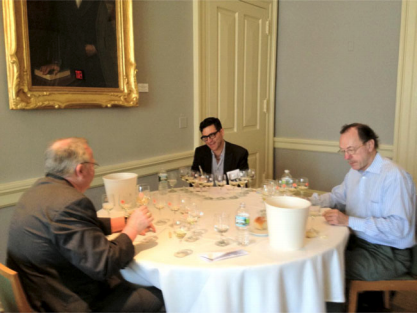
Judges were seated three to a table, and all ten wines in the white flight had been
poured in front of them. Before the tasting started, there was a brief explanation of
procedures. It was announced that scoring would be on the basis of twenty points,
which was the method Spurrier used and which remains a common European way
of judging, rather than the one-hundred point American system. Some judges were
unfamiliar with that, so it was explained.
Then the tasting started. There was little talking during the judging, with the nine
participants quietly evaluating the glasses one by one and then scoring the wines.
Sometimes judges went back for a second sample before writing down their score,
and sometimes changed their initial number.
Paper slips for the red wines. The letters were written on the slips after the drawing.
The white-wine tasting was completed in slightly over a half hour, and then the
judges left the room, while waiters cleared the old glasses and then poured the red wines into new ones. The red-wine tasting went just as quickly and just as smoothly. There again was almost no discussion, and the judges carefully reviewed the ten glasses in front of them. Following the red-wine competition, the judges left the room.
Results of the tasting were announced shortly after at the nearby Woodrow
Wilson School auditorium. Orley Ashenfelter and Richard Quandt, who is also
a professor at Princeton, gave brief interpretations of the results. Quandt’s full
analysis of the tasting can be found in this issue of the Journal of Wine Economics.
Cameron Stark, whose Unionville Pheasant Hill Single Vineyard Chardonnay,
placed second among the Chardonnays to Beaune Clos des Mouches Joseph
Drouhin, was pleased with his result. “The tasting was like a small tremor, and for
the first time we were taken seriously,” he said. Stark is a graduate of the famed
University of California at Davis wine program and worked in California before
moving to New Jersey. He says the state is still searching to find its best grape
varieties to grow in a region that must battle with excessive rain and humidity during
the growing season. He thinks Chardonnay is perhaps the best white and has great
hopes for Rhône Valley reds.
Heritage Estate Reserve BDX scored best among the New Jersey reds and placed
third overall in that category after Mouton Rothschild and Haut-Brion. Heritage is
a classic Bordeaux blend aged in French oak. Owner Bill Heritage says his family
has been in agriculture for five generations, but he planted his first vines only in
1999. He has been gradually expanded wine-grape production, while still growing
apples, peaches, and other crops common to New Jersey’s Outer Coastal Plain,
which he thinks is the state’s best region for wine. Heritage made only 125 cases of
the 2010 Reserve BDX.
Heritage says that the some dozen producers making quality wines in the state
cooperate well together to lift everyone’s output. He learned winemaking first
through extensive reading and wine tasting to determine what people drank. He also
has traveled to all major American wine regions and dreams of getting to France to
see what he can learn there.
Looking back on the competition, Judge Robert Hodgson, a California
winemaker, owner of Fieldbrook Winery, a judge at the California State Fair
Wine Competition and author of several articles on scoring at wine tastings and
competitions in this Journal (Hodgson, 2008, 2009a, 2009b) , was quite content. He
has been tasting wines for fifty years, has enjoyed many of the world’s great wines,
although he admits it was mostly in the old days when he could still afford them. He
judged wines at the tasting on the basis of a new method he’s been developing that
scores on anticipation, balance, and satisfaction. Says Hodgson: “My ego got a real
boost when Richard Quandt remarked that statistically speaking, I did quite well.
My mantra is that someone will do well.”
(150) The Judgment of Princeton
After the Judgment of Paris results in 1976 were announced, one of the judges
demanded to have her scorecard back, seemingly to stop her scores from becoming
known. After the Judgment of Princeton, some of the judges also objected to having
their individual scores released. In both cases, though, the full tasting results were
made public. The outcome of the Judgment of Princeton, just as it had been at the
Judgment of Paris, was very interesting.
References
Hodgson, R.T. (2008). An examination of judge reliability at a major U.S. wine competition.
Journal of Wine Economics, 3(2), 105–113.
Hodgson, R.T. (2009a). An analysis of the concordance among 13 U.S. wine competitions.
Journal of Wine Economics, 4(1), 1–9.
Hodgson, R.T. (2009b). How expert are “expert” wine judges? Journal of Wine Economics,
4(2), 233–241.
George M. Taber (151)

Raising the Vision of Central Valley Growers at Grape Day 2014
Raising the Vision of Central Valley Growers at Grape Day 2014
By Matthew Malcolm, Assistant Editor
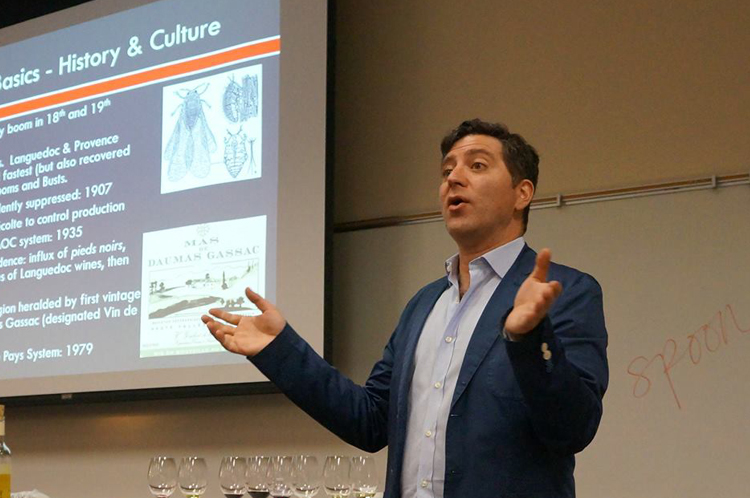
Grape growers filled the halls of the Viticulture and Enology Research Center and toured the Fresno State vineyards, observing current research projects underway for the benefit of the California grape industry at the 2014 Grape Day. Growers in attendance also had the opportunity to enjoy a complimentary lunch providing by American Vineyard Magazine, and listen to speakers who addressed current industry studies and concerns. The keynote speaker featured at this event was Jamal Rayyis, an internationally noted writer and wine critic.
A Vision of Central Valley Wine — Past, Present & Future
“Wine is something to be enjoyed everyday, and if we want wine to be a regular part of the consumers diet, it has to be affordable; and the Central Valley really provides a way for that,” stated Jamal Rayyis. The purpose of his presentation was to help growers understand the value and potential of the Central Valley’s wine grape industry.
Viticulture in the San Joaquin Valley has been going on successfully since the 1870s. Those who started growing grapes here were trying to grow varieties that worked well for wines of different types, many of which are not common today. It was not until the 1970s, when a boom in wine consumption hit that growers began turning to the common wine grape varieties we see today such as: pinot noir, Cabernet Sauvignon and chardonnay. Before the 1970s though, sweet wine was the dominant type produced in the valley.
The fact of the matter is that consumer preference changes over time, and growers can take advantage of that. “I can tell you forty years ago, people were not drinking Merlot,” Rayyis said. “When it first came on to the market, there was a lot of curiosity; then it got big in the late 1980s and more growers began planting them. People’s wine tastes change, and it would be great if growers here would take advantage of the assets they have in front of them to grow grapes and create wines with distinction, that are not like other wines in California.”
Rayyis explained that growers should continue growing the powerhouse varieties they currently do to supply the market demand, but he believes they can explore other varieties that perhaps grow better here and make Central Valley wines more desirable and valuable.
“Taking advantage of hot climate grapes that have shown to grow well in the Central Valley would be a good thing to incorporate with the more common varieties like Pinot Noir, Merlot and Chardonnay,” expressed Rayyis. He recommended growing Alicante Bushet, a variety with very unique qualities. Although not a highly regarded grape in a lot of places, he believes it would do well here and, if produced in an interesting manner, provoke the interest of many wine consumers.
Other hot climate grapes to consider are Grenache Petit Sirah and Carignane, or Italian varieties such as Aglionico and Negro Amaro. Rayyis pointed out that the varieties from southern Italy make very interesting wines and are grown in conditions very similar to that of the Central Valley, and the Italian growers have even less access to water to irrigate.
As the problem with water in the valley increases, growers are looking for drought resistant rootstocks and also varieties that will thrive under recent conditions. “There are a number of grape varieties that thrive in very arid conditions that produce very aromatic grapes,” explained Rayyis. “But they are just not part of the parlance, and the fact of the matter is that consumers might be willing to try and adopt them if they were available to them.” On that note, Rayyis believes that Central Valley growers can adopt these varieties and have a lot of success with them, culturally and economically. Rayyis’ presentation concluded with an educational wine sampling where growers compared European and Central Valley wines.
Predicting Ideal Harvest Date by Measuring Seed Texture
“I am a firm believer in a tight relationship with grape quality and maturity,” stated Hend Letaief, professor from the Department of Viticulture and Enology at Fresno State. Letaief introduced a new indicator of grape ripening by measuring seed texture. “Depending on climatic conditions and soil type, grape seeds can reach their optimal “textural” maturity up to two weeks before commercial harvest,” she explained.
Most compounds in the berry ripen at the same time, but by following the seed maturation, growers should be able to predict the optimal grape harvesting date up to three or four weeks in advance. This would help wine grape growers in their preparations for harvest, knowing that far ahead of time. In the lab, it takes Letaief only 15 minutes to process samples from a vineyard to calculate the stiffness, toughness and crispness of the seed to identify its maturity level.
Foliar Potassium Applications on Table Grapes
“About 99 percent of all U.S. grown table grapes come from California and over 100 million boxes were shipped to more than 60 countries in 2012,” said Sonet Van Zyl, from the department of viticulture & enology at Fresno State University. Addressing table grape growers, Van Zyl noted that those with early and late ripening varieties tend to get higher prices for their grapes. For those pushing to get an earlier crop and increase the maturity of their fruit, she proceeded to talk about the role of potassium (K).
She noted that K is a key element in grapes, making up three percent of the fresh weight of the fruit. K increases the overall quality of grapes, bringing higher levels of sugar, starch and color accumulation in the fruit. It can also facilitate an earlier harvest or mature a larger crop on the vines. The soil does not always have sufficient K levels, so growers often apply it with foliar sprays. K deficiencies can cause problems such as: restricting the growth of shoots and fruit, increasing the risk of drought stress, and can lead to sugar entrapment and accumulation in the leaves. To avoid these problems and facilitate an earlier harvest, Fresno State researchers applied two foliar applications of K on the vineyard. They made applications of either water or 1.3 g/L of K at veraison and three weeks after.
Results showed that the K treatments caused significant increases in soluble solids in both ‘Sweet Scarlet’ and ‘Sweet Royal’ varieties. It increased berry K content, firmness and color intensity, while berry size and firmness declined significantly. For growers that want an earlier harvest, Van Zyl concluded that applications of K following veraison appear to be promising.
Raisin Rootstock Research
Matthew Fidelibus, an extension specialist at UC Davis, explained that there has been a lot of research going on in rootstock development, primarily in the Central Valley. He urged growers to take greater advantage of it. “Most rootstocks have more tolerance to salts than own-rooted vines do,” he expressed. “In the current situation where we are relying more and more on groundwater, there is less of it available. Overtime if we do not start to see a replenishment of our water supply, we are going to see a decline not only in the availability of water but also in water quality. So we want to be thinking of rootstocks as not only a guard against soil-pests, but also as a helpmeet to get by with lower quality irrigation water.”
Fidelibus said that growers have been using Freedom and Harmony rootstock for about 45 years and they have served them well for many years; however, there have been strains of root knot nematodes that have evolved to overcome the resistance of these rootstocks. “So we have a need for new rootstocks,” he said.
The good news though, is that Dr. Peter Cousins, a geneticist with the USDA-Agricultural Research Service, has developed approximately 800 untested rootstock selections through his rootstock program over the years. “So we have a lot to work with, but we need to narrow this down to a couple of really good rootstocks for grower use,” Fidelibus expressed. “We are going to be very strict with these rootstocks, because we really want a few distinct rootstocks with good qualities.”
Fidelibus explained that they are looking for specific traits to correct some of the issues growers are experiencing with current varieties. For example, potassium is really important for sugar accumulation, a key factor in raisin grape production. Freedom performs much better in potassium intake than 1103P; however, both rootstocks have a high accumulation of nitrogen.
Selma Pete, an early-ripening raisin grape variety, tends to have low levels of zinc. Zinc deficiencies cause poorer fruit-set and often reduces crop-size and berry weight. Growers have to watch carefully for this and may need to supplement the vines with a zinc treatment. A better rootstock, however, with higher zinc accumulation, could correct that. “These are the kind of things we are looking into in developing new rootstocks,” Fidelibus expressed.
“We are looking at new rootstocks to improve the longevity and the performance of your vineyards, he stated. “So we may be able to come up with the best rootstock you could want to have, but it is going to be up to you to be careful in your management, so that you retain the integrity of your rootstocks and get the best performance that you want from them.”
In his concluding remarks, Fidelibus explained that he has been to many vineyards on rootstock where he has seen the graft covered in soil. In this situation, the scions take root and it becomes an own-rooted vine, thus losing the integrity and benefits of the rootstock.
Photosynthesis Chamber to Measure Vineyard Evapotranspiration
Out in the field, graduate student Andrew Beebe, explained the University’s current work on new methods to better identify how to measure the irrigation needs of grapevines to maximize water-use efficiency. This has become exceptionally important in times of drought like this.
Beebe has been working with a photosynthesis chamber, used to measure the photosynthetic rate on a per-vine basis and the evapotranspiration rate of the vines. It is made of an ultra-thin mylar material that covers the vines. The material traps the gases emitted by the plant, so that Beebe can measure CO2 and humidity levels in the canopy. An air conditioning unit is used to blow air into the chamber until it comes to equilibrium. “By measuring the CO2 and humidity going into and on top of the chamber, we can find out how much water the vine is actually using,” Beebe said. “From there, we will be able to determine how many acre-feet of water it takes to produce one ton of fruit.”
In this experiment, Beebe explained that the university has been comparing different regulated deficit irrigation treatments to determine how to maximize yields with less water. They cut water off 50 percent crop ET from fruit-set to veraison and compared that to a deficit irrigation treatment, using 80 percent crop ET throughout the entire season.
“With this data, we can see the effects of reduced water amounts per tonnage, and we are finding that the treatment did not actually effect tonnage,” he said. “We are also monitoring quality, measuring anthocyanin development through the season at different phenological stages, and we are finding there is no difference when using the applied reduced amounts of water. It does not stress the vines, you can use less water and still produce the same tonnage.”
Grape day was a benefit to raisin, table and wine grape growers alike and provided insights regarding the future of the industry, also giving growers practical advise on how to adapt to the changing times for the overall improvement of their operations.
Learn more about the topics addressed at Grape Day by watching video interviews with industry experts who spoke at the event on CaliforniaAgNet.com or AmericanVineyardMagazine.com.
Single Lake – Single Vineyard

Appearing in Wine & Spirits Magazine, September 2012
Perhaps it was Providence.
After graduating from the Viticultural Research Institute at Neustadt in Germany, Hermann J. Wiemerís first job was to make sacramental wines in upstate New York, from the most ignoble of grapes, vitis labrusca. The year was 1965. The native of Bernkastel in the Mosel had no intention of remaining longer than two years. And, he indeed left, only to be lured back in 1968 by the entreaties of Walter Taylor, who was starting Bully Hill Winery in sight of Seneca Lake, the largest of the seven Finger Lakes. Ironically, Wiemer’s job at Bully Hill required him to make wines from vitis labrusca as well as French-American hybrids such as vidal blanc and baco noir. But he had other plans. Now, nearly 45 years later, Wiemer is largely credited with pioneering the move to single-vineyard wines, an effort that has confirmed the Finger Lakes as a prime growing region for riesling.
Those looking for a story that he possessed a divining rod for riesling will be disappointed. ìI just got really lucky,î he says.
Wiemer noticed the peach and cherry trees growing in the area ñ signs, according to German folk wisdom, that (vinifera) grapes could thrive. He’d also learned from his father, a master vine-grafter, the possibilities afforded by the right rootstock. And, just west on the shores of Keuka Lake, Dr. Konstantin Frank had been producing riesling since 1962, off vines heíd planted in 1958. While Wiemer and Frank hadn’t much contact, Frankís work confirmed riesling could succeed.
He decided to plant his first vineyard in an abandoned soybean farm in Dundee, about one mile from the shores of Seneca Lake. “We had no concern about terroir back then. I just didn’t want my grapes to die. I took that land because the terms were what I could afford, a contract sale at $359.99 per month, like buying a car”.That was in 1973. There were no viticultural studies he could consult; people at Geneva [New York State Agricultural Experiment Station] only thought about yields, hybrids, and native grapes. “They didn’t even think about vinifera,” he recalls.
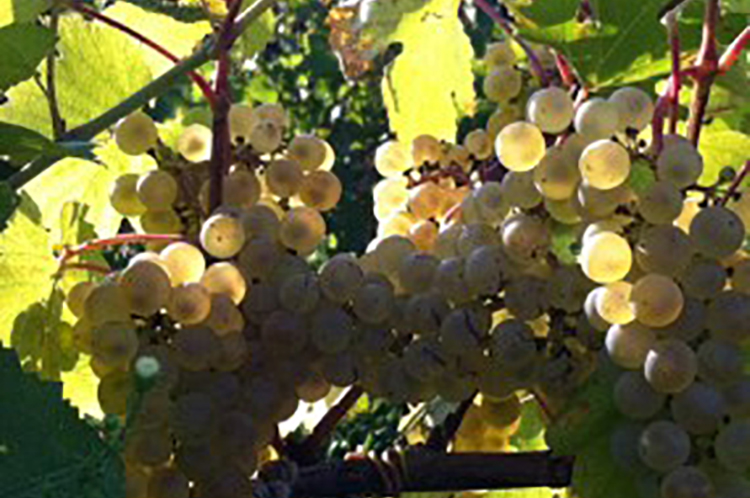
An autumn grape cluster. (Photo is property of Hermann J Wiemer Vineyards)
Wiemer started slowly, planting seven acres of riesling and chardonnay in 1974. “At the beginning, we didn’t know what the soil would do. We did crude tests for limestone – which wasn’t present – but that was about it. One thing we knew we needed was drainage, so we installed drainage tiles three feet below the surface. Otherwise, the ground could turn hard as cement after it rained.” That vineyard, now called HJW, is planted on aurora silt loam, a soil that’s poor in organic material; it’s a mix of sandy gravel with shallow topsoil, heavy clay at the base and solid shale underneath.
Cold winter temperatures also offered a challenge. The Mosel river valley gets cold in the winter, but not quite as cold as central New York State can. And while Seneca Lake doesn’t freeze in winter, radiating warm air along its shores, Wiemer took the precaution of burying the base of his vines with soil before the winter to protect from hard freezes. A freeze in late 1980 referred to as the “Christmas Massacre” dropped temperatures to -15∞ F, seriously damaging vines throughout the region. Ten miles up the road, however, a riesling vineyard the Taylor family planted five years earlier showed no damage at all. Wiemer kept an eye on the property, and in 1989 purchased 56 acres of it. Later studies from Cornell have shown that this property is in the warmest zone of the Finger Lakes, due west of the deepest part of the lake.
Wiemer realized fairly quickly that the site encompassed two distinct terroirs: while it was all Honeoye silt loam, a sand-like rich, humus-based soil with good drainage and little clay content, one side of the road was flat, while the other tilts slightly south. On that slope, the soil is poorer, more eroded and sand-like with streaks of shale in parts; the vines grow less vigorously there.
Wiemer vinified them separately, but it wasn’t until 2007 that the winery began bottling them separately, when Wiemer retired and his assistant, Fred Merwath, took over. “While we thought it would be great to showcase them,” Merwath recalls, “Hermann was reluctant to add more wines to the production. [Also, Hermann had a hard time coming up with names for the vineyards ñ n.b. a detail not in original W/S article]” They named the sloped parcel Magdalena, after Wiemer’s mother, and the flatter one after his father Josef.
Tasting the three single-vineyard wines together, the differences are easy to perceive. The HJW stands out for its leanness and its fine, mineral structure; in comparison, Josef and Magdalena are rounder and more tropical in flavor, with the Magdalena markedly brawnier in stature.
Today, a handful of other wineries are also producing single-vineyard rieslings in the Finger Lakes, including Ravine’s Argetsinger Vineyard and Bloomer Creek’s Tanzen Dame Morehouse Road Vineyard – some of the region’s most touted wines. As Finger Lakes winemakers gain more experience and confidence, there will surely be more. As Wiemer, who cites the centuries-old recognition of single vineyards in Europe, puts it, “Single vineyards, understanding terroir, just take time and a lot of work to know what you have. We’ve only started understanding that in the last ten years. The Finger Lakes is a place you can make great, distinctive wines. That is, if you really want to.”
Welcome to the Revised PS Website
Please pardon our ‘Latin’, as the PS website is currently under ‘construction’
[content_slider]
[content_slide]

Integer nulla odio, mattis at leo sed, aliquam rutrum purus. Ut sed gravida libero, imperdiet condimentum lacus. Vivamus vehicula ligula vel orci malesuada vehicula. Vestibulum vitae dolor in enim ornare suscipit. Phasellus sodales felis nisl, quis ornare est rutrum et. Proin metus leo, ultricies sed vulputate eget, eleifend et metus. Phasellus luctus lorem tristique, faucibus lacus id, lacinia eros. In dignissim purus vitae lectus auctor, vel tempor massa maximus. Nunc auctor lacus et nisl placerat lobortis.
[/content_slide]
[content_slide]

Vestibulum vitae dolor in enim ornare suscipit. Phasellus sodales felis nisl, quis ornare est rutrum et. Proin metus leo, ultricies sed vulputate eget, eleifend et metus. Integer nulla odio, mattis at leo sed, aliquam rutrum purus. Ut sed gravida libero, imperdiet condimentum lacus. Vivamus vehicula ligula vel orci malesuada vehicula. Phasellus luctus lorem tristique, faucibus lacus id, lacinia eros. In dignissim purus vitae lectus auctor, vel tempor massa maximus. Nunc auctor lacus et nisl placerat lobortis.
[/content_slide]
[content_slide]

[/content_slide]
[/content_slider]
Fusce dapibus porta consequat. Maecenas ut ante id purus rutrum vulputate. Donec diam justo, ultricies a suscipit eu, facilisis scelerisque nisl. Vivamus vitae urna erat. Mauris vehicula, turpis sed tristique facilisis, ipsum enim vehicula eros, ut blandit elit sapien eget dui. Mauris convallis sollicitudin neque, quis finibus lectus facilisis sit amet. Proin massa libero, molestie sed arcu in, volutpat lacinia est. Cras tempor nibh id cursus consectetur. Cum sociis natoque penatibus et magnis dis parturient montes, nascetur ridiculus mus. Ut ligula sapien, hendrerit non pretium eu, accumsan vel odio. Praesent vel nibh a magna iaculis faucibus. Sed a cursus metus. Mauris varius at lectus a posuere.
Mauris sapien velit, suscipit vitae mi ut, finibus mollis neque. Quisque mauris nulla, pretium in luctus id, malesuada in sem. Donec aliquam hendrerit pulvinar. Phasellus convallis mattis enim at convallis. Etiam quis elementum ipsum. Suspendisse mattis erat nec vehicula posuere. Ut consequat aliquam urna, sed porttitor purus auctor sed. Sed auctor a magna vitae faucibus.